Friday, September 21, 2012

A CLOSER LOOK AT MINIMALIST RUNNING SHOES


Minimalist footwear is the newest and fastest growing segment of the athletic footwear industry today!  The appeal for consumers seems to be the purported benefits of decreased injury risk and/or performance enhancing effects of minimalist shoes.


            Manufacturers are marketing these shoes as more natural and more like being barefoot. Despite the fact that athletic footwear manufacturers spent the previous four decades extolling the virtues of their cushioning technologies and stability devices, some have now changed their tune and want to make sure you know that their shoes are now much more like being barefoot.  There is a whole new way of thinking about running footwear and we can sum this up as “less is more.”  The established manufacturers such as Brooks, New Balance, Asics, Adidas and others have introduced minimalist lines to compliment their established models. 
            The minimalist type of footwear has been available all along.  For some unknown reason, the tipping point came recently and piqued the interest of the media and running consumers.  Prior to the recent launch of the wave of minimalist shoes, traditional running shoes had been moving, even if slowly, toward thinner midsoles and lighter weight. 
What exactly is a Minimalist Shoe?
This really depends on who you ask.  As with any other category of footwear, there are no strict criteria that formally define a minimalist shoe.  The manufacturers seem to be setting their own criteria.  They are made to be light, flexible and minimally restrictive of foot motion within the shoe. 
            If you are going to decide to choose the Minimalist Shoe, there are a couple of things you need to consider. Only 10% of people are able to wear them because they only work for certain foot types.  You need to also consider the terrain that you are running on and if it works well for these types of shoes.   In conclusions, we will have to wait for the final verdict if the minimalist shoe can support the needs of the many.  Enjoy pain free running!


Saturday, September 15, 2012

Preventing Falls in the Elderly

PREVENTING FALLS IN THE ELDERLY

            An important public health issue that has become more prevalent in podiatry today is the issue of fall prevention in the elderly.  One in three adults over the age of 65 falls each year and a half of these people fall multiple times.  The Centers for Disease Control and Prevention report that falls are the leading cause of injury related deaths in people over the age of 65.  In 2000, the cost of treating non-fatal fall related injuries was $19 billion and is expected to double by 2020.

What are the risk factors for falling?

            With multiple levels of input and output from the central nervous system to provide us with proper muscular activation to respond to unexpected hazards, it is easy to see how numerous risk factors associated with aging can predispose people to traumatic falls.  The medical literature has identified many independent risk factors for falling. The risk factors include previous falls, balance impairment, decreased muscle strength, visual impairment,  more than four medications,  psychoactive drugs, gait impairment, and walking difficulty, depression, dizziness or orthostasis, age older than 80 years, female sex, incontinence, cognitive impairment arthritis, diabetes, and pain. 
            More than one risk factor increases the risk of falling, with no risk factors the risk of falling is 8 percent and grows to 78 percent with four.  More alarming is the finding that the risk of falling quadruples for a patient within two weeks of discharge from the hospital. 
            Medications that physicians commonly prescribe for elderly patients can negatively affect all aspects of our neuromuscular control of the body during gait.  While the use of four or more medications from any category of drugs will increase the risk of falling, identifying certain drugs that can independently increase the risk is more difficult.  In general, an increased risk of falling is associated with the following medications:  serotonin reuptake inhibitors, tricylic antidepressants, neuroleptic agents, benzodiazepines, anticonvulsants and class IA antiarrhythmic medications.  Withdrawal of these medications becomes a complicated issue when considering fall prevention.  Many times the condition patients are taking the medication for is itself a risk factor for falling.
            Most of our elderly patients experience a decline in balance and muscle strength.  The combination of this decline with visual and vestibular compromise increases the risk of falling. What can be done? One way that podiatrists offer relief from imbalance issues is the MBB or Moore Balance Brace. It is all about making it easy for the elderly. The MBB has been designed to easily fit into a variety of different shoes. Because the MBB is so light weight and has a sleek design, the MBB is easy to wear.
            The type of shoe used with MBB is important and should not be left to the patient alone to figure out. There are many light weight stable shoes that are options for seniors, but care needs to be taken to make sure that the MBB is not being used in a house shoe or slipper or without shoes. You should see your Podiatrist to evaluate your needs because your quality of life is the most important to us. 
  

Saturday, September 8, 2012

Recognizing and Treating Lower Extremity Gout

Recognizing and Treating Lower Extremity Gout

Gout is an inflammatory arthritis that results from high uric acid in the blood, from either the body’s overproduction or under excretion of uric acid.  It typically presents with acute onset and can be recurrent.  The first metatarsophalangeal joint (MPJ) is involved in 90% of individuals with gout. Gout can result in joint deterioration and destruction. 
            For the last two years, gout has been much more recognizable to the public in print, TV, and other forms of media.  The painful condition of gout is now more appreciated as the number of gout medications, formulations and reformulations has changed the landscape for the public and patient base, and thus changed the management by physicians. 
The actual number of true gout cases is likely underestimated.  Many times patients and physicians treat this with OTC analgesics or anti-inflammatories without the proper diagnosis and workup for gout.  High uric acid in the blood is the cause of gout.  There is an increasing prevalence with significant presence of one or more disorders (or diseases) including cardiovascular disease, hypertension, renal insufficiency and metabolic syndrome. 
Researchers have stated that gout affects approximately 5 to 6 million people in the United States with prevalence on the rise. Gout reportedly occurs more in men that in women, affecting 2 percent of men older than 30 years of age.  Risk factors include being male, postmenopausal, a strong family history, kidney disease, organ transplants, excessive alcohol use, a diet high in purines, (red meat and seafood) metabolic syndrome, obesity, dehydration, and exercise.   Studies have shown that heavy alcohol use in general, particularly beer, increase the incidence of gout whereas moderate use of red wine, did not.
            It is well known that the incidence of gout is higher in people with increased dietary intake of purines, particularly meat and seafood, as well as ingestion of beer and spirits, soft drinks and fructose.  It is lower in those with increased intake of coffee, dairy products and vitamin C (all lower uric acid levels).  It must be clarified that coffee and tea can also increase uric acid levels and the presentation of gout.  Purine-rich foods such as fruits, vegetables and foods that include a high citrus content can affect the balance between urate reabsorption and secretion which is critically linked to the uric acid elimination in urine. 
            In conclusion, gout is relatively common inflammatory arthritis that occurs in all age groups.  It can be particularly debilitating disease, causing limitation of activity and lowering the quality of life.  It is now associated with the comorbidity of other systemic diseases. If you feel you may have gout or any symptoms of gout, see your doctor to help diagnose and treat this disease. 

Saturday, September 1, 2012

How To Prevent Ingrown Toenails

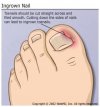
HOW TO PREVENT INGROWN TOENAILS

An ingrown toenail is one of the most painful foot conditions we often bring on ourselves. Although sometimes ingrown toenails are hereditary, they're most often caused by incorrect nail trimming -- and they become even more painful when they're squeezed by shoes that are too short and tight. Fortunately, there are simple steps you can follow to help prevent ingrown toenails.
The best tip for preventing ingrown toenails is: trim your nails straight across the top -- NOT in a rounded shape. In addition, avoid wearing shoes or socks that squeeze your toes together.

If you are diabetic or have poor circulation, seek professional attention.

Suggestion to prevent a problem:
  • Switch to longer shoes with a bigger toe box at least 1/2 an inch from tip of your longest toe.
  • Soak your foot in a solution of 1/4 cup of white vinegar to one gallon warm water for 10 minutes twice a day if infection is present and contact your Podiatrist
  • If you believe you have the start of an ingrown toenail, then apply an antiseptic or betadine ointment after you have soaked in vinegar solution. This is especially important, because one of the greatest dangers of ingrown toenails is the possibility of infection.  And seek Podiatric care.

Another great way to prevent ingrown toenails is to come in to see a Podiatric Nail Technician for a professional pedicure or manicure!

Thursday, April 5, 2012

Hurting Heels..

If you have recently changed your shoe gear, with or without introduction to new sporting activities or increase in intensity in your workouts, chances are this could be related to pain in the back of heel/foot. This area is the location for a very strong tendon called the Achilles tendon. A condition of irritation and inflammation in this area is referred to as Achilles Tendonitis. Many times, long distance runners who increase their mileage can develop this.
One of the most common reason for Achilles Tendonitis is due to the loss of flexibility. As people age, flexibility is amongst the first things to go especially for those who are not regular exercisers. With loss of flexibility, the back part of the foot becomes more rigid and less strong, therefore leading to injury upon sudden changes or repetitive trauma (for example long distance running or walking).
Middle-age recreational athletes are the most susceptible to Achilles Tendonitis.
The most common complaint by patients is pain in the back of the heel, about an inch or two from the ground. Interestingly, patients complain of having more pain in the beginning of activity and less pain during, unless the activity involves forced movements or jumping. Another common complaint is also increased pain upon waking up and the first few steps out of bed.
If you are experiencing such symptoms, your podiatrist is a specialist in diagnosing this condition and putting together a specific, personalized treatment to help you get better as soon as possible. Your podiatrist will have an umbrella of treatment options and tests needed to best diagnose your condition and fast recovery will not come soon enough unless professional help is sought.  

Saturday, February 11, 2012

LIVING SIX FEET UNDER, MENTALLY!

It is not uncommon, especially in certain populations, that people are living lives in a fashion that might seem totally unrealistic to the norm. People are living in health conditions where one disease seeming scary enough, some have five or six different serious health conditions, and they continue to live a life that a ‘normal person’ would never understand.
Let me give an example of a patient not uncommonly seen in a hospital setting; a 58 year old male, who has suffered from a previous heart failure, is obese, weighing roughly around 370 lbs, has been drinking most of his life and smoking for 40 + years, is diabetic and has huge swollen legs.
And despite all of the proof out there, he cannot stop his bad habits; though he might be able to recognize them. He does not check, (or care to check?) his blood sugar regularly, so they are usually high. [In my previous blogs I talked about why high blood sugar level is extremely bad for the body). And although he claims to have cut down on his drinking, he cannot discontinue his smoking. This patient that I am describing also needs a wheelchair to get around, mainly because he has developed severe arthritis in his knees and cannot walk on them properly. It has come to a point that it is hard for him to get in and out of his wheelchair fast enough to go to the restroom so he has to carry around a urinal. On top of this, due to his diabetes, he has developed diabetic neuropathy which has led him to have a couple quarter sized ulcers (holes in skin) on the bottom of his foot which are not healing because his health is very poor. It is possible, if these ulcers do not heal and instead get infected, that he might need to amputate part of his foot.
And so, it comes down to why and how?
How can someone live like this and why do they choose to live like this. I believe the problem lies much deeper and is very complicated. Many patients as described above also suffer from psychiatric issues which have one way or another pulled them so deep down in the dark that they feel they will never recover. They feel that their life cannot get any better and cannot get any worse. And so they continue their ways. This is clearly not a healthy state to be in. It can lead to many tough health decisions for doctors, and us as physicians do not ever wish our patients to be in such a state.
What is important is that it takes a while for a person to get to this level, and if you or someone you know is similar in the pattern described above, or feel are treading down this path, they need your and professional help. They need close family members looking out for them, and although it might take time, a healthier and better outcome will be much more worth it in the end as opposed to not caring and letting a human being just slip away into their misery. There are many Behavioral human services organizations and consultations near your area code and a quick Google search will bring forth numerous. Such an act is a must upon everyone and it can truly make a difference in a family member, friend or a neighbors’ lifestyle. 

NATURALLY COLORED NAILS PERHAPS...?!!

Nails are not something that come in different shapes, forms, color etc. Perhaps that has to be a constant in the differences present in each human being. However, since most people have wondered at least once in their life as to the existence of finger nails, more people on a regular basis ignore anything funny going on with them. People in general are more prone to pay better attention to their finger nails than toe nails and that is simply because one remains hidden as opposed to the other which are almost always seen. This being said, people will generally tend to ignore changes taking place in their toe nails, whether this maybe the increase in length, shape including the thickness of the nail, smell, lines in the nails, decrease in thickness or increased brittleness to name some. However, most of the time people do take the time to come in the clinic when nail growth in the corners starts causing pain.
Normal, healthy individuals do not endure such changes of the nails on a normal basis as my patients who have multiple health risks such as Diabetes, alcohol addictions, smoking, unhealthy lifestyles and at times all these together. Nails changes are quite common in those who have serious health risks and thus these nail changes cannot be ignored. Proper care by a podiatrist is important because nails can be little portals for infections to start, and if there is a cut around the area, can cause the infection to spread inside of the body and this can lead to not so comforting outcomes, including but not limited to thorough exams, more frequent clinic visits and lastly amputation of the toe if the infection gets worst and if it gets into bone. If the infection gets in the bone, it has a tendency to disrupt the normal functioning of the bone and start to spread up the bone, destroying the bone in the process. This can further lead to more bone having to be taken out à more amputation.
This might sound scary, and extreme, but the key to this is if you have serious health risks/disease, nail care is just as important as checking your blood sugar or your blood pressure. It cannot be ignored just because there is no pain and podiatry visits are a must.