Friday, November 30, 2012

Corns and Calluses! What are they?


Corns and calluses are thickened layers of skin caused by repeated pressure or friction. They are annoying and sometimes painful thickenings that form in the skin in areas of pressure. Corns and calluses can be prevented by reducing or eliminating the circumstances that lead to increased pressure at specific points on the hands and feet. They can be treated with many types of medicated products to chemically pare down the thickened, dead skin. They can also be removed by debriding or cutting the corn or callous with either a scalpel or dremel.  People with fragile skin or poor circulation in the feet (including many people with diabetes or peripheral arterial disease) should consult their health-care professional as soon as corns or calluses develop.

Causes

Corns and calluses are caused by pressure or friction on skin. A corn is thickened skin on the top or side of a toe, usually from shoes that do not fit properly. A callus is thickened skin on your hands or the soles of your feet.

The thickening of the skin is a protective reaction. For example, farmers and rowers get callused hands that prevent them from getting painful blisters. People with bunions often develop a callus over the bunion because it rubs against the shoe.

Neither corns nor calluses are serious conditions.                
                                                                                                  Picture of Corn(Left) and Callus(Right)
Symptoms

  • Skin is thick and hardened.
  • Skin may be flaky and dry.
  • Hardened, thick skin areas are found on hands, feet, or other areas that may be rubbed or pressed.

Exams and Tests

Your health care provider will make the diagnosis after observing the skin. In most cases tests are not necessary.

Treatment

Usually, preventing friction is the only treatment needed. If a corn is the result of a poor-fitting shoe, changing to shoes that fit properly will usually eliminate the corn within a couple of weeks. Until then, protect the skin with donut-shaped corn pads, available in pharmacies. If desired, use a pumice stone to gently wear down the corn.

Calluses on the hands can be treated by wearing gloves during activities that cause friction, such as gardening and weight lifting.

If an infection or ulcer occurs in an area of a callus or corn, unhealthy tissue may need to be removed by a health care provider and treatment with antibiotics may be necessary.

Calluses often reflect undue pressure placed on the skin because of an underlying problem such as bunions. Proper treatment of any underlying condition should prevent the calluses from returning.

Outlook (Prognosis)

Corns and calluses are rarely serious. If treated properly, they should improve without causing long-term problems.

Possible Complications

Complications of corns and calluses are rare. People with diabetes are prone to ulcers and infections and should regularly examine their feet to identify any problems right away. Such foot injuries need medical attention.

When to Contact a Medical Professional

Very closely check your feet if you have diabetes or numbness in the feet or toes. If you have diabetes and notice problems with your feet, contact your health care provider.

Otherwise, simply changing to better-fitting shoes or wearing gloves should resolve most problems with corns and calluses.

If you suspect that your corn or callus is infected or is not getting better despite treatment, contact your health care provider. Also call your health care provider if you have continued symptoms of pain, redness, warmth, or drainage.

Saturday, November 17, 2012

Diabetes Awareness Month


DIABETES AWARNESS MONTH


      Diabetes is a condition of elevated blood sugars where the body does not produce enough insulin to meet the body's needs or the body does not respond properly to the insulin being made. Insulin is important because it moves glucose (or sugar) into the body's cells from the blood. It also has a number of other effects on metabolism.
The medical name of this condition is diabetes mellitus. It is sometimes referred to as "sugar diabetes." There is another form of diabetes, called diabetes insipidus, which is a relatively rare condition in which the kidneys are unable to conserve water, leading to excessive urination. When people talk about diabetes, they are usually referring to diabetes mellitus.
         The food we eat provides our bodies with glucose, which is used by the cells as a source of energy. If insulin isn't available or doesn't work correctly to move glucose from the blood into cells, glucose will stay in the blood. High blood glucose levels are toxic, and cells that don't get glucose are lacking the fuel they need. These two problems cause the symptoms of diabetes.
          There are two main kinds of diabetes mellitus: type 1 diabetes and type 2 diabetes. More than 90% of all people with diabetes have type 2. Overall, about 30 million people in North America have diabetes. Only about two-thirds of people with type 2 diabetes are aware of it and are receiving treatment because, for many people, its early symptoms are not noticeable without testing.

       Type 1 diabetes used to be called "juvenile" diabetes, since it usually occurs in people under the age of 30. Everyone with type 1 diabetes needs to take insulin on a daily basis.
Type 2 diabetes used to be called "adult-onset" diabetes, because it usually occurs in people over 40. People with type 2 diabetes usually have a family history of this condition and most are overweight. People with type 2 diabetes are treated with a combination of lifestyle changes and medications. Some may eventually need insulin. Certain ethnic groups are at higher risk of developing type 2 diabetes. This includes but is not limited to Native American, Hispanic/Latino, South Asian, East Asian, Pacific Island, or African descent.
      Another less common form is gestational diabetes, a temporary condition that occurs during pregnancy. The problem usually clears up after the baby is born, but women who have had gestational diabetes have a higher risk of developing type 2 diabetes later in life. Diabetic neuropathy is damage to the nerves that allow you to feel sensations such as pain. Diabetic neuropathy is the most common complication of diabetes. There are a number of ways that diabetes damages the nerves, mostly related to blood glucose being too high or uncontrolled. Depending on the affected nerves, symptoms of diabetic neuropathy can range from burning and numbness in your extremities to loss of total sensation. These symptoms are mild, for others, diabetic neuropathy can be very uncomfortable, disabling and sometimes fatal.


DIABETIC NEUROPATHY
SYMPTOMS

  • Numbness or reduced ability to feel pain or changes in temperature, especially in your feet
  • Tingling, burning or prickling sensation that starts in your toes or the balls of your feet and gradually spreads upward
  • Sharp, jabbing pain that is worse at night Extreme sensitivity to the lightest touch — for some people, even the weight of a bed sheet
  • Loss of balance and coordination
  • Muscle weakness and difficulty walking
  • Serious foot problems, such as ulcers, infections, deformities, and bone and joint pain


 Ingredients
Diabetic Foot Care Guidelines
Inspect your feet daily. Check for cuts, blisters, redness, and swelling. Use a magnifying hand mirror to check the bottom of your feet.
Wash your feet in luke warm water. Keep your feet clean by washing them daily.
Moisturize your feet-not in between the toes. Use moisturizing cream daily to keep your feet from becoming dry and cracking.
Cut nails carefully-straight across. Also, file the edges. Do not cut them to short; this could lead to ingrown toenails. Never trim corns or callouses.
Wear clean socks. Wearing white socks will show signs or bleeding or drainage.
Avoid socks that are too tight. Avoid tight elastic bands (they reduce
circulation).
Shake out your shoes and inspect the inside before wearing.
Remember, you may not feel a pebble, so always shake out your shoes before wearing them.
Never walk barefoot. Not even at home! Take care of your diabetes. Keep your blood sugar monitored and under control.
Do not smoke. Smoking restricts blood flow to your feet.
Get periodic foot exams. See your podiatrist on a regular basis for an exam to prevent foot complications.

Recipe for THANKSGIVING!


  • 2 teaspoons margarine
  • 3/4 cup chopped onion
  • One 16-ounce can pumpkin puree (not pumpkin pie filling)
  • 2 cups Homemade Chicken Broth OR canned reduced-sodium chicken broth
  • 2 teaspoons sugar
  • 1/2 teaspoon salt
  • 1/8 teaspoon ground cloves or ground nutmeg
  • 1 cup fat-free milk
Directions
  1. Melt the margarine in a medium saucepan. Saute the onion until softened, about 5 minutes.
  2. Add the pumpkin, broth, sugar, salt, and cloves; stir to mix well. Bring to a boil; reduce the heat and simmer for 15 minutes.
  3. Puree until smooth in a blender or food processor. Return to the saucepan. Add the milk; heat thoroughly but do not boil. Serve at once.

Friday, November 9, 2012

What are Hammertoes?


Hammertoes are an arthritic condition of the feet.   Shoes that are too narrow or too shallow will contribute to the formation of this deformity.  What most people do not know is that the foot structure will also contribute to hammertoe formation.  People with very high arches will tend to develop hammertoes because the toes begin to ride up on the metatarsal bones which are the bones just behind the toes. 
Additionally, people whose feet are very flat will also tend to develop hammertoes because of a weakness that develops in the foot musculature from the feet constantly flattening out when they walk.  Once the toes become crooked, they become difficult to fit in conventional shoes (the square peg in the round hole idea).  They even become more difficult to fit into a high style women’s dress shoe.  But because society dictates it many people, particularly women, will continue to “stuff” their feet into them. 
What then occurs is that the hammertoe deformities become more pronounced and more painful.  As Podiatrists, we make a distinction between flexible hammertoes, which are basically crooked toes that can be pulled straight, (even though they will not stay that way).  And rigid hammertoes that are bent in the crooked position and will not straighten out. 
When hammertoes are forced into shoes on a regular basis, the shoe begins to rub on the body prominences of the toes.  Anytime there is constant pressure on a bone, the bone to hypertrophy or enlarge.  This further creates more friction between bone and shoe. 
This added friction will then cause a number of things to occur.  The most common of which is the formation of a corn, or hard skin overlying the part of the toe that is constantly hitting the shoes.  This corn can be on top of the toe, on either side of the toe, or at the end of the toe, depending on the degree of deformity.  Keep in mind, that corns are formed by the body to protect the area from friction so in a sense they are a good thing.  The problem arises is when they begin to hurt. 
Along with the formation of Corns, the constant pressure will also cause the toe to become red and swollen in that area and very painful to touch.  This is usually indicative of bursitis formation. 
If the hammertoe is rigid, tendons on top of the toe may also become inflamed, plus because the hammertoe puts so much retrograde or backward pressure on the metatarsal bones, it can also cause pain on the ball of the foot. 
Treatment
Treatment should be to remove the friction or pressure on the toes which would be to change your shoe style into something more conservative, for example a boxier, wider heel. Maybe a slight modification of your shoe gear may help.  It is recommended to not use medicated corn pads because the medication in them contain acid which can eat right through your skin which creates an ulcer and ultimately and infection (especially bad if you are diabetic).
You can also have your podiatrist remove the corns by paring or debriding them away. Rarely does this cause a problem but many people will get many months’ worth of relief.  If you are a diabetic or have poor circulation you should get your corns taken care of on a periodic basis.
Other treatments include a combination of non-steroidal anti-inflammatory (NSAIDS) along with orthopedic inserts or orthotics that can give temporary relief. 
At this point if you are not ready to stop wearing those heels, or you don’t want to keep coming back to the doctor to get your corns removed, you may have to entertain surgical correction.  When we evaluate hammertoe surgery we look at the architecture and alignment of all the toes even the ones that don’t hurt.  There are a few different types of surgery for hammertoes and your doctor will decide which one is best for your situation. 
If you have any of the problems that were mentioned above, do not hesitate to call your local podiatrist to get rid of those pesky hammertoes and corns. Because remember, when your feet hurt, you hurt all over!

Tuesday, November 6, 2012

What is Chilblains?

Chilblains also known as chilblain, pernio and perniosis are small, itchy swellings on the skin, which are not painful at first, but can become painful - they are acral ulcers; ulcers affecting the extremities. They are a localized form of vasculitis that occur when a predisposed individual is exposed to cold. Exposure to the cold can damage tiny blood vessels (capillaries) in the skin, resulting in redness, blisters, itching and inflammation. The itching, swelling and blistering red patches may occur on the toes, fingers, ears and nose.


Treatment for chilblains, which consist mainly of topical remedies and medications, is usually effective and the patient makes a full recovery within a couple of weeks. If left untreated though, there is a risk of complications, such as skin ulcers, cracked or broken skin, and infections.

Vulnerable individuals who wrap up warmly, or stay away from the cold as much as possible are much less likely to develop chilblains.
 

What are the signs and symptoms of chilblains?

Chilblains signs and symptoms generally appear a short while after being in the cold. There will be a burning and itching sensation, usually in the extremities, such as the feet, hands, nose or ears. Symptoms get worse if the individual walks into somewhere warm.

The skin of the affected area may go red and become inflamed (swollen). Sores and blisters may appear (rare).

Doctors say that signs and symptoms will usually go away within a couple of weeks on their own if the patient avoids exposure to cold. More rarely, recovery may take months.

What causes chilblains?

Our blood vessels narrow when exposed to cold. When returning to warmth , the blood vessels expand again. For some people, this change results in blood leaking out of the blood vessels, causing inflammation and chilblain symptoms, especially if the change from cold to warmth is abrupt.

What are the complications of chilblains?

Chilblains may sometimes lead to infections, skin ulcers, and scarring. Complications are generally linked to an underlying condition/illness.

How are chilblains diagnosed?

Diagnosing chilblains is straightforward. If symptoms are present and the patient has been exposed to the cold, a doctor will diagnose chilblains.

What is the treatment for chilblains?

The patient can treat chilblains that have not developed into and infection or skin ulcer with OTC medications purchased at a pharmacy.

Patients have had good results by applying a mixture of friar's balsam and a weak iodine solution (ask your pharmacist).

A corticosteroid cream may also help with symptoms of inflammation and itching. If the skin is cracked you should see your doctor.

How are chilblains prevented?

To prevent chilblains:
·                          When it is cold, dress appropriately, this includes warm footwear (shoes and socks), gloves, a hat and scarf. In other words, wear clothing that protects your feet, hands and ears from the cold. You can protect your nose by wrapping something like a scarf around part of your face.
·                          Some people find that placing cotton wool between their toes helps circulation
·                          If you are particularly susceptible, try to avoid exposure to cold as much as possible
·                          When coming back from the cold, do not expose susceptible areas to sudden warmth (a gradual process is better).
·                          Exercise - do plenty of exercise at least four times a week; this helps maintain good circulation
If you have any of these signs and symptoms, call your podiatrist and schedule an appointment, because remember, “When your feet hurt, you hurt all over!”

From medicalnewstoday.com

Monday, October 29, 2012

High Heels and Foot Pain: What You Should Know


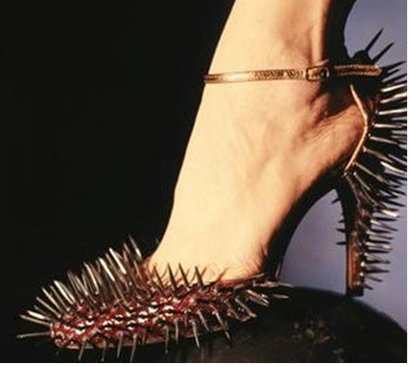
            It's true that nothing can lift the spirits like a sassy new pair of high heels.   But if it seems those heels were a lot more comfortable in your 20s and 30s then they are in your 40s, 50s, and beyond, you're right. Feet change with age, say experts, and some of those changes can make wearing high heels a lot less comfortable.  One of the most common: a loss of fat in the bottom of the foot. As you age, you lose some of the fatty deposits that normally protect the ball of the foot -- and some of it also slides forward towards the toes.
            Anytime you wear shoes that are tight or constrict the natural shape of your foot, doctors say it's bound to cause foot pain. But when you add high heels in to the equation, pain can quickly escalate to damage. In addition to restricting the foot, you are also increasing the weight on the area that is restricted, so you're not only crushing your toes, but you're crushing them and then putting weight on them, and that's a problem Among the most common problems he sees are painful, aching bunions -- those bony protrusions that usually pop up at the base of the big toe and distort the shape of the foot.
            High heels don't cause bunions, but they sure can aggravate them. Both the heel height and the point of the shoe can play a role. Some women who have bunions also have a displaced bone on the bottom of the big toe joint, which changes the way the foot "tracks" or acts during motion. If the foot is then placed in a high heel, and pitched forward, the pressure on these bones increases and bunion pain grows worse. While integrating lower heels into your wardrobe can help some, often the best solution is bunion surgery to straighten the bone.
            If you're wearing high heels on a daily basis, it's likely you've already experienced two more common problems: corns and calluses. These thickened layers of dead skin usually occur on the toes or sides of the foot and are actually the body's way of defending your feet against assault. Only in this case your shoes are the enemy. When you start developing corns and callus, or even ingrown toe nails, pressure from shoes that don't quite fit is often the problem. Other times it can be the result of a "hammertoe" -- a condition that causes the bone of the affected toe to curl under, leaving the top to rub against the shoe. When that shoe is a high heel, problems and pain are intensified. While wearing a lower heel shoe can help some, the solution may require a surgical procedure that helps straighten the hammertoe. Call your podiatrist if you have any problems or concerns.  Because when your feet hurt, you hurt all over!!


Monday, October 15, 2012

How To Quit Smoking!

The majority of cigarette smokers quit without using evidence-based cessation treatments. However, the following treatments are proven effective for smokers who want help to quit:
·                         Brief clinical interventions (i.e., when a doctor takes 10 minutes or less to deliver advice and assistance about quitting)
·                         Counseling (e.g., individual, group, or telephone counseling)
·                         Behavioral cessation therapies (e.g., training in problem solving)
·                         Treatments with more person-to-person contact and intensity (e.g., more time with counselors)
Cessation medications found to be effective for treating tobacco dependence include the following:
·                         Nicotine replacement products
o                                        Over-the-counter (e.g., nicotine patch, gum, lozenge)
o                                        Prescription (e.g., nicotine inhaler, nasal spray)
·                         Prescription non-nicotine medications, such as bupropion SR (Zyban®) and varenicline tartrate (Chantix®).
The combination of medication and counseling is more effective for smoking cessation than either medication or counseling alone.
Quitline Services
1-800-QUIT-NOW is a free telephone support service that can help individuals who want to stop smoking or using tobacco. Callers have access to several types of cessation information and services, including:
·                         Free support and advice from experienced counselors
·                         A personalized quit plan
·                         Self-help materials
·                         Social support and coping strategies
·                         The latest information about cessation medications
·                         Over-the-counter nicotine replacement medications for eligible participants (in more than half of U.S. states)


Information provided by: www.cdc.gov

Monday, October 8, 2012

Why Should You Wear Orthotics?

Almost anyone can benefit from orthotics, from children to adults but the question is whether they really need orthotics. Orthotics can alleviate many common foot problems that cause pain and discomfort in otherwise healthy people. An analogy can be made between orthotics and eyeglasses—both devices adjust problems that can impair physical function. It’s just like wearing glasses. They adjust your vision, allowing you to see, whereas orthotics will adjust your feet, allowing you to walk correctly.  In both cases, a physician performs a complete examination and then prescribes the proper amount of correction.
There are several common symptoms that may show misalignment of the feet. These signs and symptoms include the following:
·                       Abnormal shoe wear (ex: one side of the sole of the shoe wears out faster than the other)
·                       Bunions
·                       Chronic arch or heel pain
·                       Foot Pain (MetatarsalgiaHallux RigidusMorton’s Neuroma)
·                       Knee Pain
·                       Low Back Pain
·                       Flat feet
·                       Frequent ankle sprains
·                       Gait abnormalities (e.g., feet pronate [slant inward] or supanate [slant outward])
·                       Shin pain (e.g., shin splints)
·                       Foot pain, hip pain or low back pain due to pregnancy
·                       Improve sports performance
                Your feet should not hurt and pain indicates that something is wrong. If foot pain is not properly treated, the condition causing it may worsen. Relief is closer than you think.
Here are a couple of things that you can see for yourself:
                 Take your shoes and socks off and sit in a chair. Rest your bare feet on the ground in front of you and notice the contour of the arch of your foot as it rests on the ground. Now stand up and notice how the arch changes its contour. When you are weight-bearing, the arch flattens out. Some people with very flexible feet have large arches while sitting that completely collapse when they are standing. Other people have smaller arches that do not change much when they stand up because their feet are more rigid. Over the counter orthotics do not take these differences into account.
                Look at the bottom of an older pair of tennis shoes to see the wear pattern. You do not need to know what a normal wear pattern is to see that yours is abnormal. Notice where the shoe has been worn down. In some areas, the tread will have been worn away. Specifically notice the wear pattern around the heel. If you look at the shoes from the back, you can usually see the wear pattern a little better. Make sure you compare your shoes to each other. Your shoes should be mirror images of each other.
If you have any of the problems listed above and you have abnormal wear on your shoes or your arch pronates too much, custom orthotic inserts are a good treatment option for you. Call your podiatrist to see what your options are! Because When your Feet hurt, you hurt all over!!